
Area Codes Serving Minnesota
Eight area codes are in service across Minnesota. Seven of them hold their own piece of the map. The eighth, 924, shares ground with 507 rather than claiming any of its own. Almost the entire arrangement traces back to 612, the code that once covered the Twin Cities and everything south of them and then gave up territory four separate times.
Two codes date to 1947 and the first numbering plan. 218 took the northern and western counties, and 612 took the rest. The 1954 creation of 507 was the only change for the next four decades. Everything after that arrived between 1996 and 2024, as the metro grew and cell phones started consuming numbers at a pace nobody had planned for.
| Area Code | Coverage | Year Assigned | Overlay Status |
|---|---|---|---|
| 218 | Northern Minnesota, including Duluth, Bemidji, Brainerd, Hibbing, Fergus Falls, Moorhead, Grand Rapids, International Falls, the Iron Range, and the North Shore | 1947 | No overlay |
| 612 | Minneapolis, plus close-in places such as Richfield, Fort Snelling, and St. Anthony | 1947 | No overlay, reduced by four splits |
| 507 | Southern Minnesota, including Rochester, Mankato, Winona, Worthington, Fairmont, Albert Lea, Austin, the Marshall region, and Northfield | 1954 | Overlaid by 924 since 2024 |
| 320 | Central Minnesota, including St. Cloud, Alexandria, Willmar, Hutchinson, Little Falls, and Mora | 1996 | No overlay |
| 651 | Saint Paul, the east metro suburbs, and river communities toward Wabasha | 1998 | No overlay |
| 763 | North and northwest metro suburbs, including Brooklyn Park, Maple Grove, and the Blaine area | 2000 | No overlay |
| 952 | Southwest metro suburbs, including Bloomington, Eden Prairie, Edina, Minnetonka, Chaska, Apple Valley, and Lakeville | 2000 | No overlay |
| 924 | The same southern Minnesota territory as 507 | 2024 | Overlay on 507 |
Minnesota Area Code Coverage by Region
Grouping the codes by region beats memorizing eight numbers. The metro carries four of them and the rest of the state carries three, with the eighth layered onto the south. Because the metro codes were carved out of one another over the space of four years, their edges follow suburban rings rather than county lines.
- Minneapolis and the inner ring is 612, including Richfield, Fort Snelling, and St. Anthony
- Saint Paul and the east metro is 651, running down the river toward Wabasha
- North and northwest suburbs are 763, covering Brooklyn Park, Maple Grove, and the Blaine area
- Southwest suburbs are 952, covering Bloomington, Edina, Eden Prairie, Minnetonka, Chaska, Apple Valley, and Lakeville
- Southern Minnesota is 507 and 924 together, over Rochester, Mankato, Winona, Austin, Albert Lea, Worthington, and Fairmont
- Central Minnesota is 320, over St. Cloud, Willmar, Alexandria, Hutchinson, and Mora
- Northern Minnesota is 218, from Moorhead across to Duluth and up to International Falls
The suburban boundaries are the ones that surprise people. A neighborhood may sit inside Minneapolis city limits and still carry a suburban code, because rate center lines were drawn for billing rather than for city halls. The 612 footprint in particular is far smaller today than the address book of anyone who has lived here since the 1990s would suggest.
The 924 Area Code Over Southern Minnesota
Southern Minnesota got the state's first area code overlay in 2024, and it changed how phones work there. NANPA forecast in August 2022 that 507 would run out of numbers. The Minnesota Public Utilities Commission opened the question for comment, held a public meeting that December, and approved an all-services distributed overlay in April 2023 under Order P-999/M-22-461. Planning Letter PL-616 from NANPA carries the same schedule and names Rochester, Mankato, Worthington, and Fairmont among the cities involved.
The Minnesota PUC announcement of the 924 code laid out the rollout for residents before any of the dates arrived.
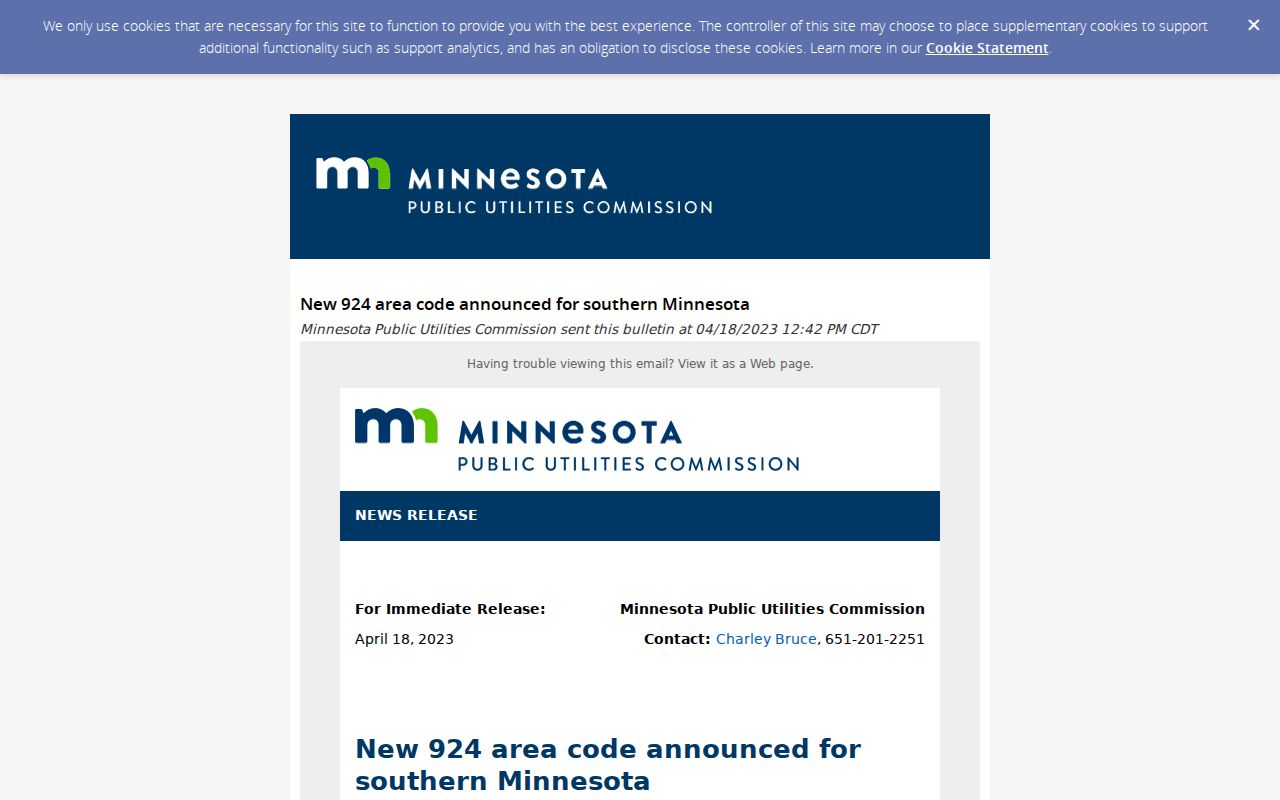
Nothing in that notice required an existing customer to change a number, which is the whole point of choosing an overlay.
Three dates carried the change. Permissive ten-digit dialing opened on January 30, 2024, giving people six months to break the seven-digit habit while both formats still worked. Mandatory ten-digit local dialing began on July 30, 2024. Carriers could hand out the first 924 numbers on August 30, 2024. Because assignment only happens as new lines are ordered, 924 still shows up far less often than 507 in daily life down there.
Overlay and Split in Minnesota Area Codes
Minnesota has used both methods, which makes the contrast easy to see without leaving the state. Five of the current codes came from splits: 507 out of 218 and 612, then 320, 651, 763, and 952 out of 612 alone. A split hands part of the old territory to a new number, and people inside that part get a new code whether they wanted one or not. The 924 arrangement is the opposite. It added a code without touching anyone's number and changed only the dialing.
- Overlay
- A second area code placed over ground that already has one. Existing numbers stay exactly as they are. New lines can draw either code, so local calls need all ten digits.
- Split
- The old code keeps part of its territory and the rest is handed a new code. People in the new region change their numbers. Minnesota did this four times to 612.
- Permissive dialing
- The window when the old and new dialing patterns both connect. It ends on a set date, after which the old pattern fails.
- All-services distributed overlay
- The kind approved for 507, meaning the new code is available to every type of service across the whole region rather than reserved for one carrier or one city.
Splits were the normal answer in Minnesota through 2000. Regulators moved away from them because forcing thousands of households and businesses to reprint everything is expensive and unpopular. That is why the 2023 decision for southern Minnesota went the other way.
Dialing Inside a Minnesota Area Code
There is no single dialing rule for the whole state. Southern Minnesota has one rule and the rest of Minnesota has a looser one. Inside the 507 and 924 region, a local call needs the area code in front of the seven digits, and it has since the summer of 2024. In the non-overlay codes, a seven-digit local call can still go through, though whether it does depends on the carrier and on where the local calling boundary sits.
Important: Local calls in the 507 and 924 region have needed ten digits since July 30, 2024. Seven-digit attempts there no longer connect.
Long distance still takes a 1 ahead of the ten digits on many landlines and office phone systems, which is a carrier setting rather than a state rule. Equipment that dials on its own deserves a look after any change like this, since alarm panels, medical alert devices, and fax machines can sit for years holding a seven-digit number nobody has tested. The three-digit service codes, the star codes, and the toll-free prefixes are covered on the Minnesota phone codes page.
How Minnesota Area Codes Grew
For most of the twentieth century Minnesota needed very few codes. Three carried the whole state from 1954 to 1996, which is a long run by national standards. Then the metro grew, second lines and fax machines multiplied, and cell phones arrived. Between 1996 and 2000 the state added three codes, all of them taken out of 612.
Each of those splits shrank the same code. 320 went first, pulling central Minnesota out in 1996. Saint Paul and the eastern suburbs became 651 two years later. In 2000 the remaining suburbs divided into 763 in the north and west and 952 in the south and west. What was left of 612 was Minneapolis and a handful of neighbors, and that compression is why the code reads as a city marker today rather than a regional one.
| Year | Event |
|---|---|
| 1947 | 218 and 612 assigned as Minnesota's original codes |
| 1954 | 507 created from parts of 218 and 612 for southern Minnesota |
| 1996 | 320 split from 612 for central Minnesota |
| 1998 | 651 split from 612 for Saint Paul and the east metro |
| 2000 | 763 and 952 split from 612, leaving it around Minneapolis |
| 2023 | Minnesota PUC approves the 924 overlay for 507 |
| 2024 | Ten-digit dialing becomes mandatory in 507, and 924 numbers start being assigned |
Note: several Minnesota codes covered far more ground in the past, so an old business card from the 1990s may show a number that has changed codes since.
Exchange Prefixes Under Minnesota Area Codes
Underneath every area code sits a set of three-digit prefixes, written as NXX and sometimes called central office codes. A prefix used to point at a physical switch building and always points at a rate center, which is the billing area a line belongs to. Duluth, Rochester, Mankato, St. Cloud, and Willmar are all separate rate centers, and the Twin Cities metro holds many of them spread across 612, 651, 763, and 952.
Third-party technical sites publish an approachable view of that data. The Local Calling Guide prefix listing for 507 shows rate centre, region, switch, operating company number, and effective date for each block.
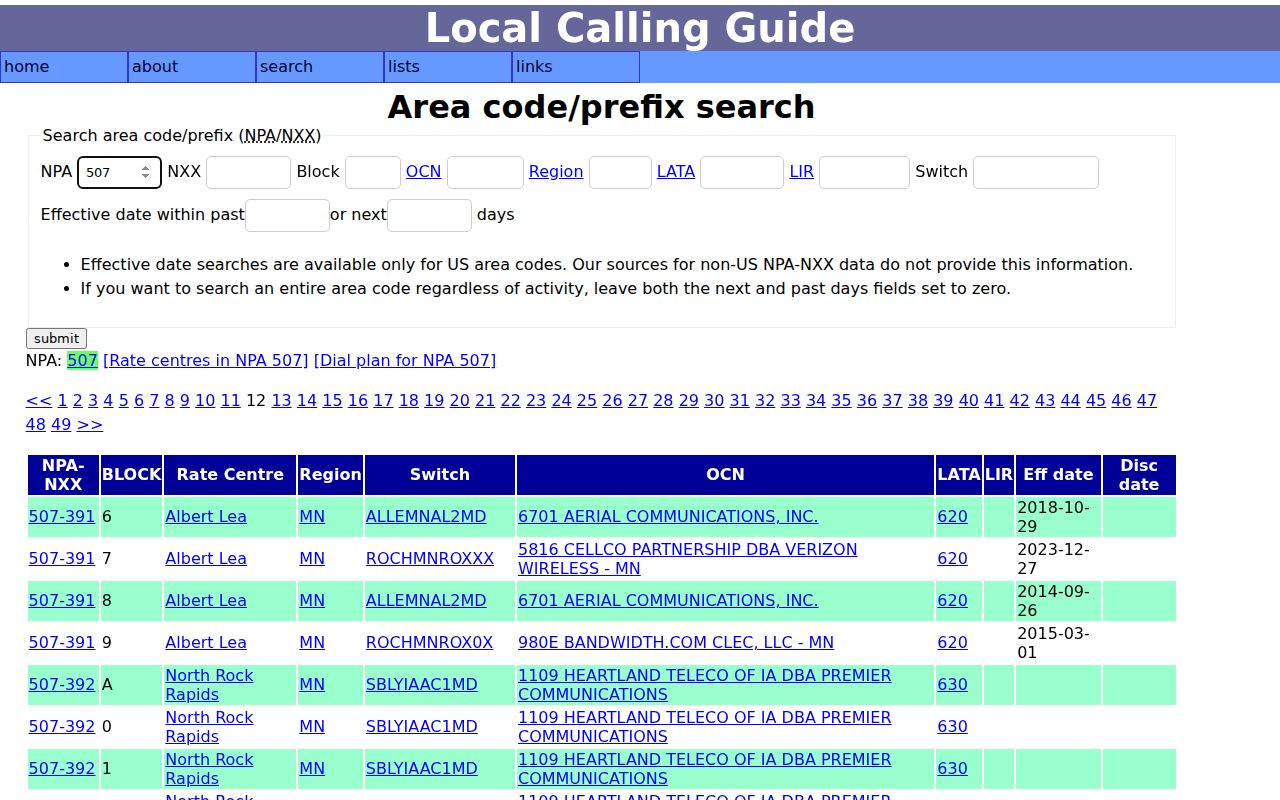
Those listings are useful for understanding where a block began, but they are unofficial excerpts rather than public records.
The authoritative version comes from NANPA, whose central office code assignment records are sorted by state and then by code and prefix.
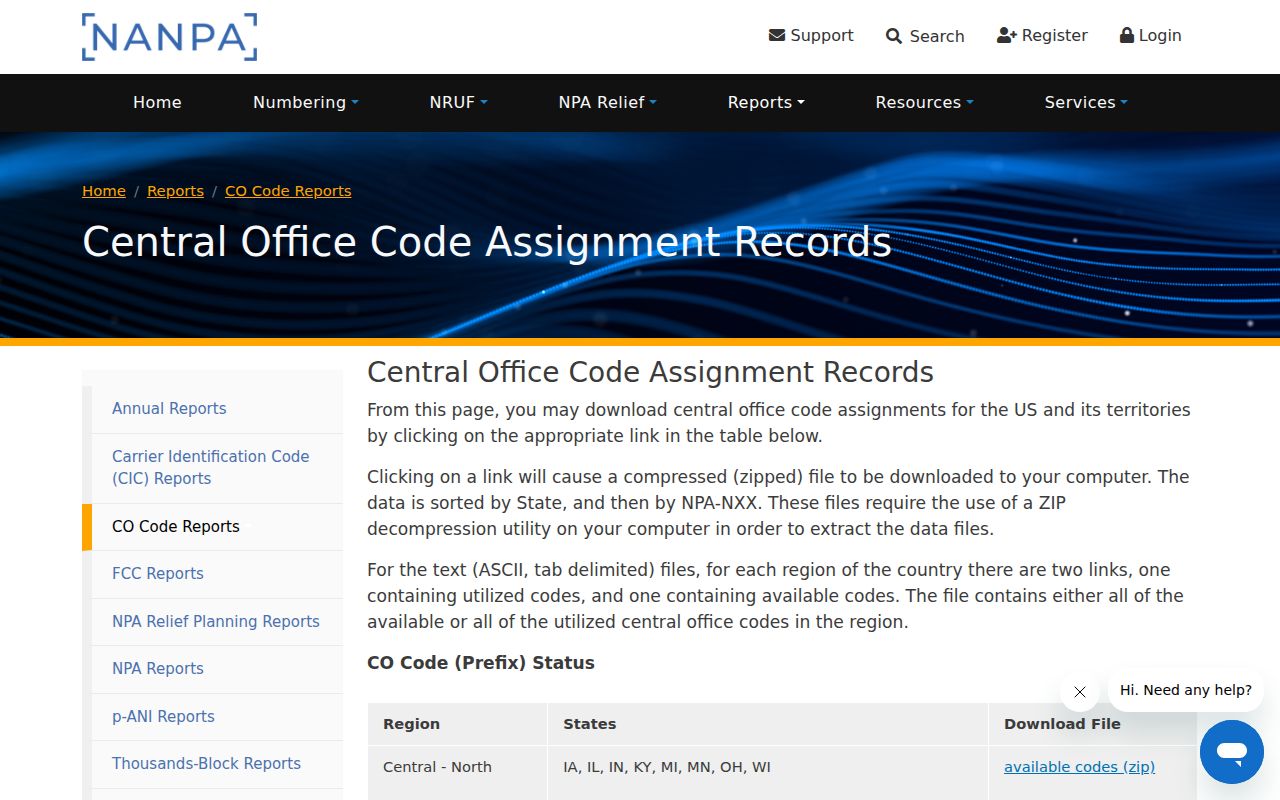
What none of these records can tell you is who serves a number today. Portability lets a line keep all ten digits while moving to another company, so a 651 prefix that started as a Saint Paul landline may be a mobile or internet line by now. Minnesota does leave recognizable patterns, though. State health numbers cluster in 651-201, human services in 651-431, Minneapolis city offices in 612-673, Hennepin County in 612-348, and Metro Transit in 612-373.
New Minnesota Area Codes Ahead
Nothing new is on the table right now. Official sources show no Minnesota relief code beyond the 924 overlay already running in the south. The place to watch is NANPA relief planning together with the Public Utilities Commission docket that produced the last one, P-999/M-22-461, since that is where a future filing would appear first.
If another Minnesota code does become necessary, the path is already set. NANPA files a petition based on how quickly numbers are being used up. The commission takes comment, holds a public meeting, and decides between an overlay and a split. Given how the last decision went, an overlay is the likelier outcome. For residents that means very little changes. Existing numbers stay put, new lines draw the new code, and local calls in the affected region move to ten digits.
Confirming a Minnesota Area Code
A caller who claims to be phoning from Rochester or Duluth is easy enough to sanity check. NANPA is the authority on which area codes exist and where they were assigned, and its code reports show which blocks are in use and which are still available.
The NANPA code reports page is the public front door to that data.
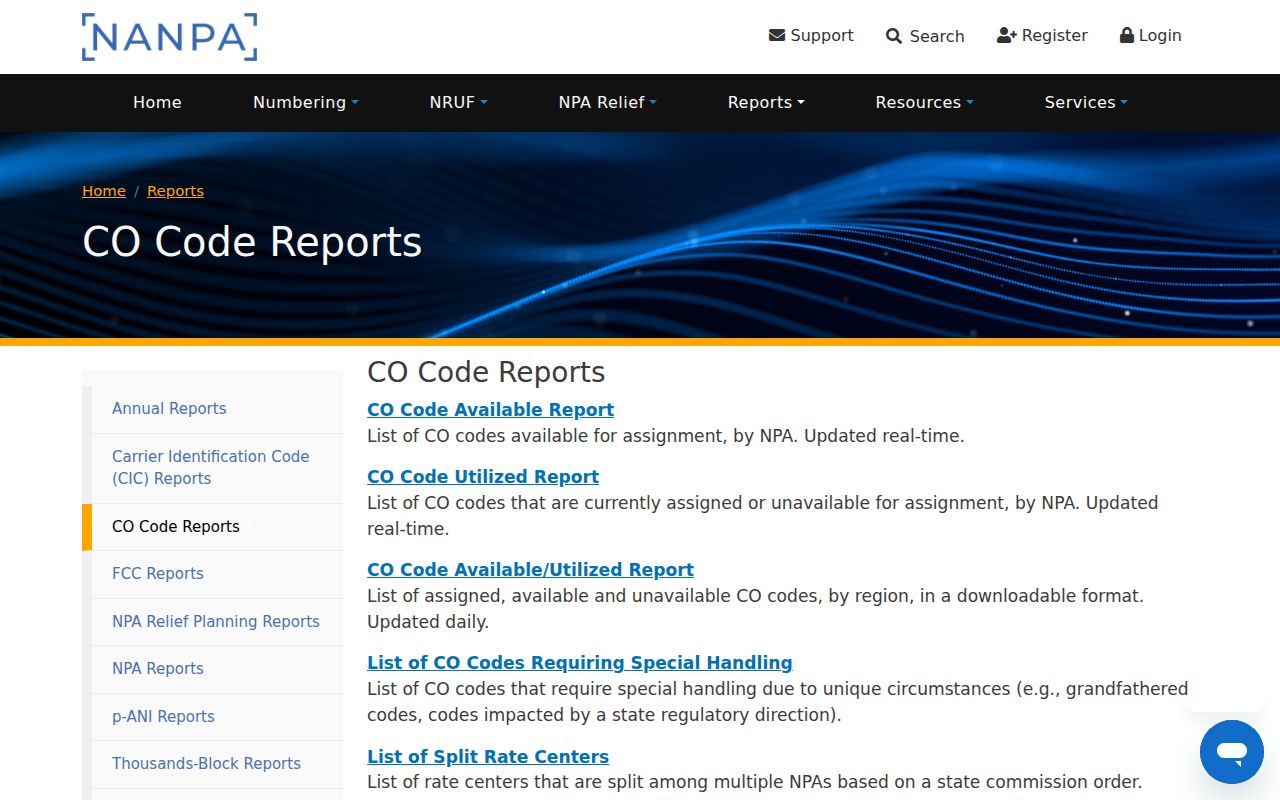
These are technical reports rather than a friendly map, so expect data files instead of a lookup box.
Confirming that a code is real is a much smaller question than confirming who is on the line. Caller ID can be faked no matter how legitimate the digits look, and Minnesota scam callers deliberately choose local codes for exactly that reason. If you need to check a specific number rather than a code, the Minnesota phone numbers page walks through the official channels.