
Which Minnesota Directory Holds Your Number
Ask people where to find a Minnesota phone number and most of them name the wrong office. State employees, county caseworkers, city inspectors, teachers, and utility crews are all listed somewhere, just never in the same place. The state runs one directory. Every county runs another. Cities publish department lists, and only a few of them offer a staff search. So the first question is not what name you need. It is which government keeps that name.
State work is the easy half. The Minnesota State White Pages searches employees by name and by agency. A brief result gives you name, agency, email, and telephone. The full display adds title, address lines, mailstop, city, ZIP, and fax. The page asks for a legal name, so try Robert rather than Bob. If more than 100 records match, it tells you to narrow the search. Questions about what a listing says go to that agency's human resources staff, not to the directory itself.
Plenty of Minnesota agencies skip the search box and simply publish a list. The Minnesota Department of Health phone directory is one of the better ones, with a line for every division, section, and district office.
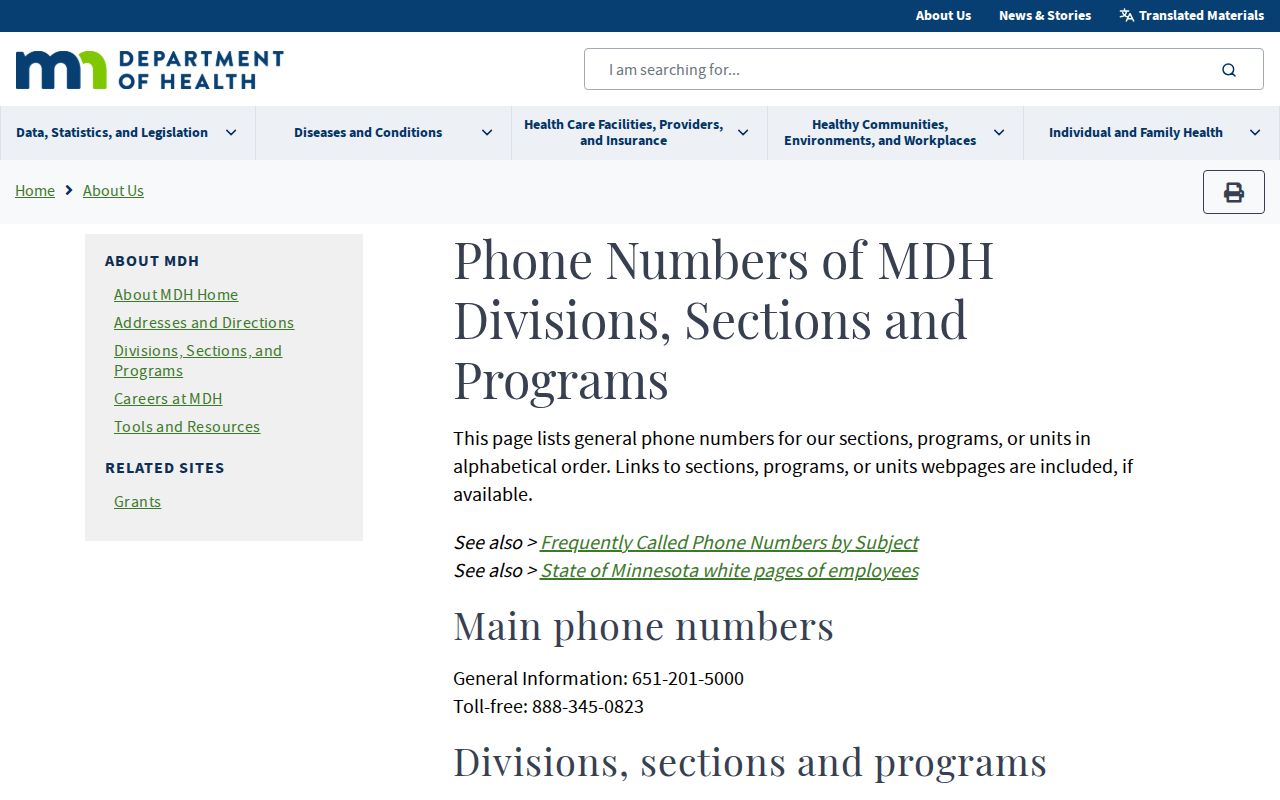
A static list like that beats a search box when you know the program you need but not the person who runs it.
- A state agency name in hand means the white pages first, then that agency's contact page if the search comes up empty.
- Anything about a pothole, a permit, or a rental license belongs to a city. In Minneapolis that means 311. Elsewhere it means a switchboard or the city clerk.
- Property records, child protection, public health, and sheriff calls are county work in Minnesota, so start on the county website.
- A teacher, a principal, or a school office comes from the district directory. No statewide list of K-12 staff exists here.
- When the need is clear but the office is not, 211 puts a resource specialist on the line who can route it.
Area Codes Serving Minnesota
Eight area codes cover Minnesota. Two of them are original 1947 assignments. 218 took the north and the west, and 612 took the Twin Cities and the southern half of the state. Everything since has been carved out of those two. Southern Minnesota became 507 in 1954. Central Minnesota became 320 in 1996. Saint Paul and the east metro became 651 in 1998, and the suburban ring split into 763 and 952 in 2000. That left 612 as a compact Minneapolis code, which is a big part of why it carries so much city identity.
One of the eight is not a place at all. 924 sits on top of 507 and shares the same southern Minnesota ground with it. Nobody in Rochester or Mankato gave up a number when it arrived. New lines down there can now come out either way, which makes a 924 number just as southern Minnesota as a 507 one.
| Area Code | Coverage | In Service | Status |
|---|---|---|---|
| 218 | Northern Minnesota: Duluth, Bemidji, Brainerd, Hibbing, Fergus Falls, Moorhead, Grand Rapids, International Falls, the Iron Range and the North Shore | 1947 | Original code |
| 612 | Minneapolis and the closest inner suburbs, including Richfield, Fort Snelling, and St. Anthony | 1947 | Original code, reduced by four splits |
| 507 | Southern Minnesota: Rochester, Mankato, Winona, Worthington, Fairmont, Albert Lea, Austin, Marshall, Northfield | 1954 | Split from 218 and 612, overlaid by 924 |
| 320 | Central Minnesota: St. Cloud, Alexandria, Willmar, Hutchinson, Little Falls, Mora | 1996 | Split from 612 |
| 651 | Saint Paul, the east metro suburbs, and river communities down toward Wabasha | 1998 | Split from 612 |
| 763 | North and northwest metro: Brooklyn Park, Maple Grove, the Blaine area | 2000 | Split from 612 |
| 952 | Southwest metro: Bloomington, Eden Prairie, Edina, Minnetonka, Chaska, Apple Valley, Lakeville | 2000 | Split from 612 |
| 924 | The same southern Minnesota ground as 507 | 2024 | Overlay of 507 |
Storing all ten digits saves trouble across a state this spread out, and in the 507 and 924 region it is no longer optional. Each code, the towns under it, and the reason the map looks this way are laid out on the Minnesota area codes page.
Minnesota Emergency and Crisis Phone Numbers
Minnesota leans on the three-digit codes more than most states do, partly because winter turns a road report into a safety question. 911 stays reserved for danger happening right now. 988 answers a mental health or suicide crisis without sending a squad car. 211 covers food, rent, and heating help. 511 covers ice, crashes, and closures on the highways, and in January that line gets a lot of use.
911 - immediate danger, fire, medical emergency, crime in progress.
988 - Suicide and Crisis Lifeline, free and confidential, 24 hours a day. The older 1-800-273-8255 line still works.
211 - United Way 211 Minnesota, or 800-543-7709, or text your ZIP code to 898-211.
511 - Minnesota road conditions from MnDOT, or 800-542-0220 from outside the state.
Poison Control - 1-800-222-1222.
Non-emergency police numbers are local, and they vary a lot. Minneapolis routes many of them through 311 or an online report, with precinct desks at 612-673-5701 downtown, 612-673-5702 for the northeast and southeast sides, and 612-673-5703 for south Minneapolis. Saint Paul asks residents to call 651-291-1111 for anything that happened a while ago. County sheriff offices run their own lines. Anoka County, for one, tells residents to call 763-427-1212 and ask for a deputy if a caller claiming to be law enforcement asks for money.
- Day One Crisis Hotline - 1-866-223-1111 for domestic and sexual violence help in Minnesota
- National Domestic Violence Hotline - 1-800-799-7233
- RAINN Sexual Assault Hotline - 1-800-656-4673
- Metro Transit Text for Safety - 612-900-0411 for behavior on buses, trains, and platforms
- Hennepin County adult protection - 844-880-1574
- Hennepin County child protection - 612-348-3552
State and City Phone Numbers in Minnesota
Two layers carry most government calls here. State agencies publish through Minnesota.gov and through their own contact pages, with the white pages tying the employee side together. Cities get no such help. Minneapolis built one of the most complete contact centers in the state, offering a 311 line, a mobile app, a web report form, email, relay service, and a walk-in service center. Saint Paul chose a different shape. Questions and complaints there route through the Department of Safety and Inspections and through individual department lines.
The Minneapolis 311 page lists the hours, the relay line, and the reporting options in one place.
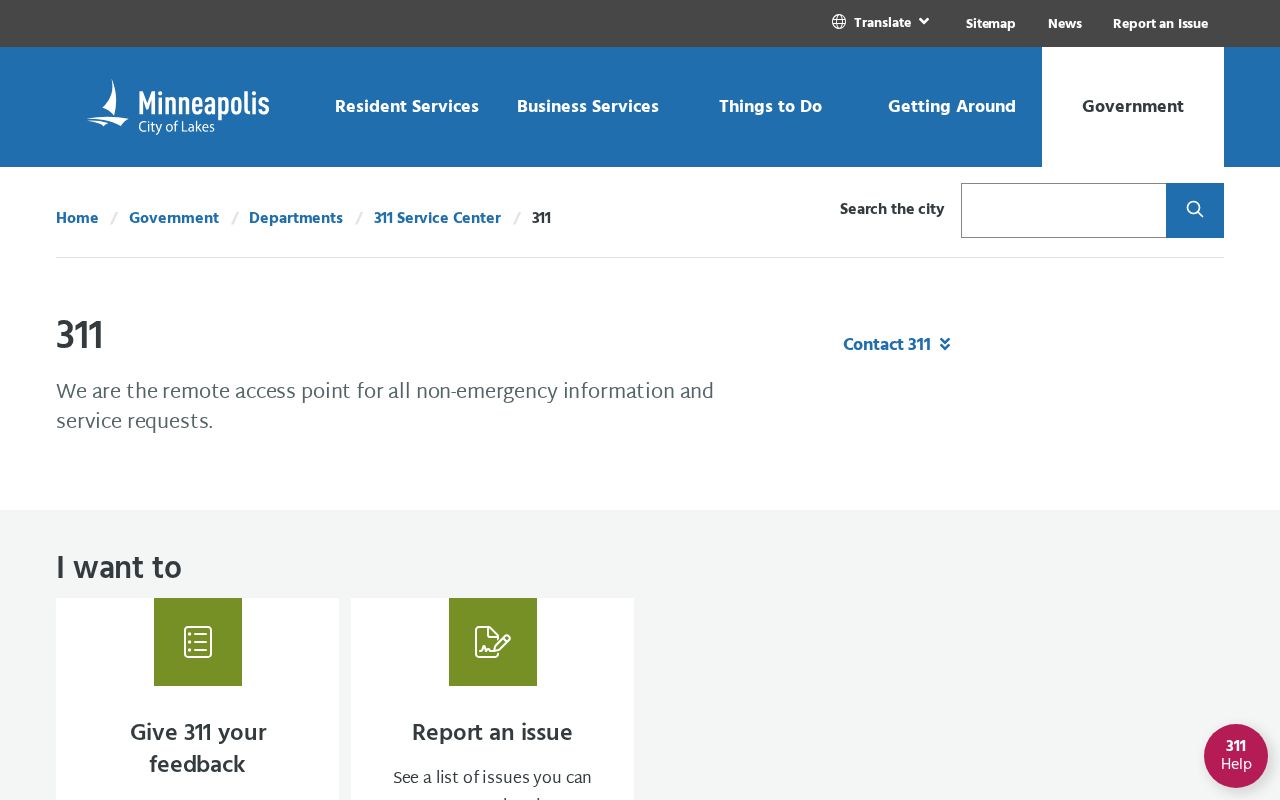
The 311 app takes a photo and a GPS point, which is how most pothole and streetlight reports reach the city now.
Minnesota State White Pages
State employee lookup by name and agency
Brief or full output
Minneapolis 311
Dial 311 inside the city
612-673-3000
7 a.m. to 7 p.m., Monday through Friday
Saint Paul Police Non-Emergency
Reports for events that already happened
651-291-1111
Smaller Minnesota cities often publish a fuller staff directory than the big ones do. South St. Paul lists direct numbers by department, including administration at 651-554-3284, building permits at 651-554-3220, the city clerk at 651-554-3204, licenses at 651-554-3208, code enforcement at 651-554-3216, and finance at 651-554-3200. North St. Paul runs the same style of category list and adds an electric department, because the city owns its own utility. Numbers like those never show up in the state white pages.
Minnesota School and Campus Directories
Education is one of the deepest phone categories in the state, and it is split across three levels. The Minnesota Department of Education answers at 651-582-8200 and runs a separate language assistance line at 651-785-4064, with help in Amharic, Hmong, Karen, Oromo, Somali, Spanish, and Ukrainian. Individual school staff are a district matter. Colleges keep their own systems again.
Saint Paul Public Schools runs the largest public K-12 staff directory anyone can search without a login. The district sits at 360 Colborne Street in Saint Paul and answers at 651-767-8100. Its staff directory held 12,150 records when it was last checked, paged ten at a time across more than 1,200 pages.
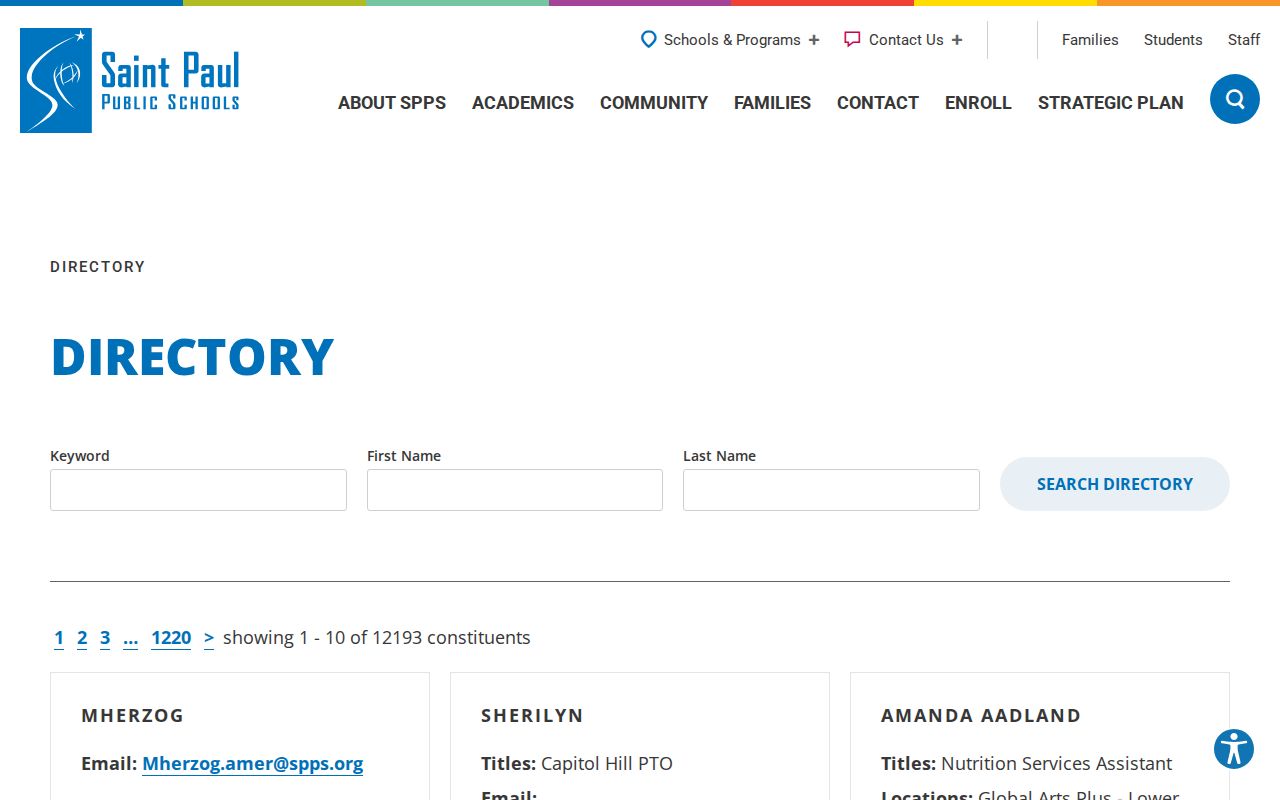
Three fields do all the filtering, and a keyword search is usually faster than paging.
| Field | Type | Required | Notes |
|---|---|---|---|
| Keyword | Text | No | Matches across the record, including role and school |
| First Name | Text | No | Staff first name |
| Last Name | Text | No | Staff last name |
| Pagination | Page links | Not applicable | Ten records per page across the full staff list |
Higher education is where the doors start closing. The University of Minnesota People Search is an internal tool. It only runs inside the University network, and the school describes that limit as a privacy and security choice.
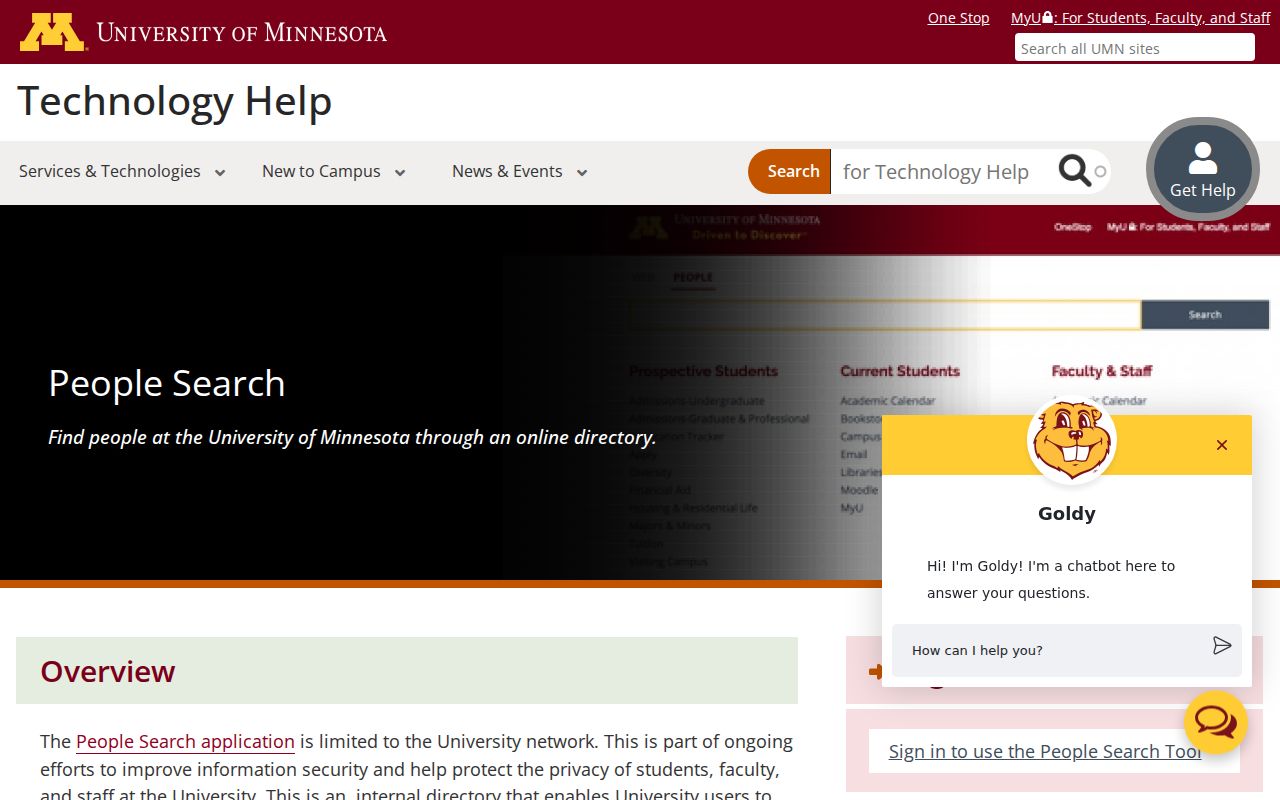
The workaround is to go one level down and use a college directory instead.
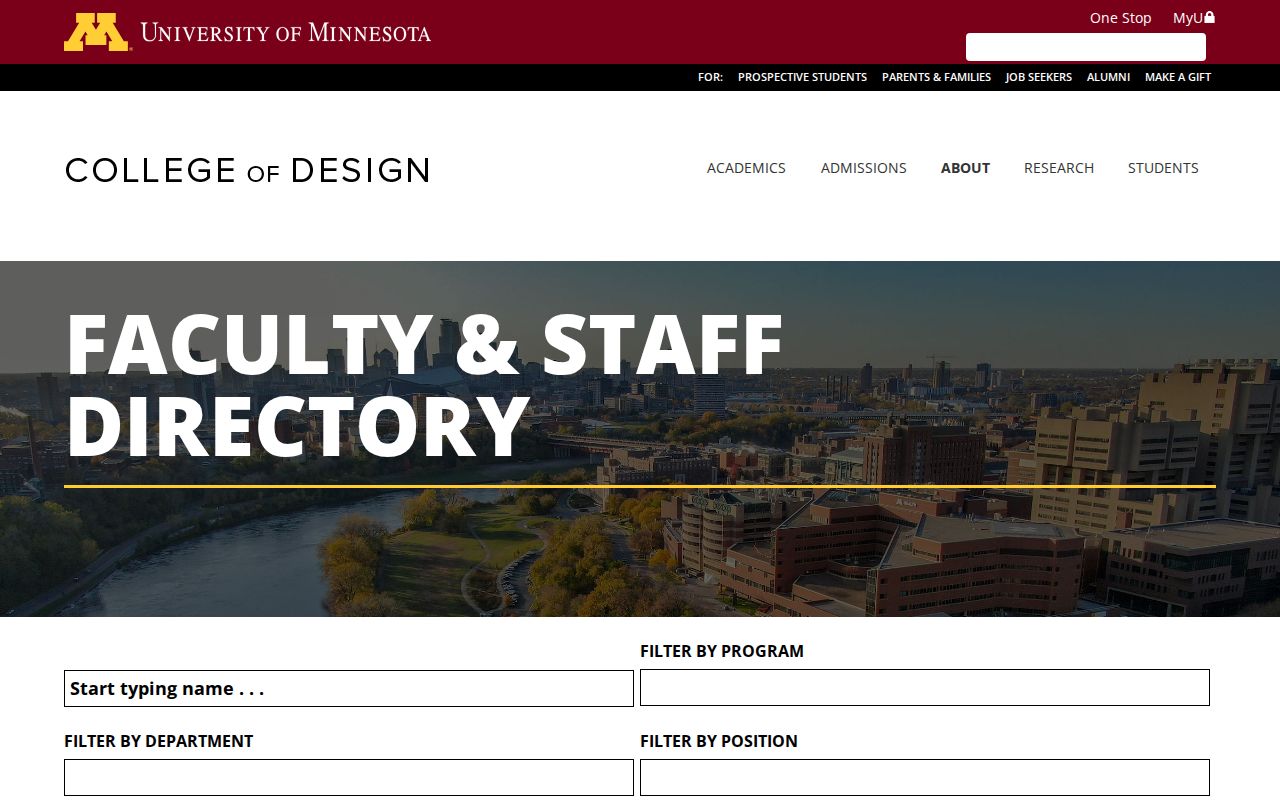
Those college pages are public, and many of them list a direct campus phone. The College of Design directory shows name, title, department, program, email, and a 612-624 campus number on a good number of entries.
For anything outside the University system, the Minnesota Office of Higher Education answers at 651-642-0567 or 800-657-3866. Library numbers stay local, with Saint Paul Public Library at 651-266-7000 and Rochester Public Library at 507-328-2300.
Note: staff directories drop teachers who left mid-year, so a school office number is the safer call when a name does not come up.
Minnesota Utility and Transit Phone Lines
Every utility keeps two kinds of number. One reaches a crew. The other reaches a clerk. Gas odor and downed wires belong on the first. Billing questions belong on the second, and calling the wrong one just adds a transfer. Minnesota puts real weight on a third number too, the one you call before digging. Gopher State One Call handles that statewide, and it splits routine locate requests from emergencies so a broken line does not wait in the same queue as a fence project.
| Service | Emergency or Outage | Customer Service |
|---|---|---|
| Gopher State One Call | Emergency locates 1-866-640-3637, answered around the clock | 811, or 651-454-0002, or 800-252-1166 |
| Metro Transit | 911 for crimes, Text for Safety 612-900-0411 for behavior reports | 612-373-3333 |
| Electric service | Your provider's outage line | Your provider's billing line |
| Natural gas | Leave the building first, then call the provider's leak line | Provider customer service |
| Water and sewer | City or municipal utility emergency line | City utility billing office |
| Utility complaints | Not an outage line | Minnesota PUC Consumer Affairs 651-296-0406 |
The Gopher State One Call center runs from 6 a.m. to 6 p.m. on weekdays between April and October, and from 7 a.m. to 5 p.m. the rest of the year. Electric and gas territory in Minnesota changes by address, so the outage number on last month's bill is the one to trust. When a company will not resolve a billing or service problem, the Public Utilities Commission takes the complaint at 651-296-0406, by email, or on paper mailed to 121 7th Place East, Suite 350, in St. Paul.
Health and Social Services Numbers in Minnesota
Two state agencies carry most of this traffic. The Minnesota Department of Health answers at 651-201-5000 or 888-345-0823 and runs district offices around the state, including Bemidji at 218-308-2100, Duluth at 218-302-6166, Fergus Falls at 218-332-5150, Mankato at 507-344-2700, Marshall at 507-476-4220, Rochester at 507-206-2700, and St. Cloud at 320-223-7300. Program lines run deep from there. Drinking water protection is 651-201-4700, emergency preparedness is 651-201-5700, and the foodborne illness hotline is 1-877-366-3455, which spells out as FOOD-ILL.
The Department of Human Services covers the benefits side. Its information desk is 651-431-2000, with TTY at 800-627-3529. Health care providers use 651-431-2700 or 800-366-5411, and members call health care consumer support at 651-297-3862 or 800-657-3672. The agency also warns against sending private data by email, which is worth remembering before typing a case number into a web form.
The DHS contact page keeps those lines together with the county and tribal routing notes.
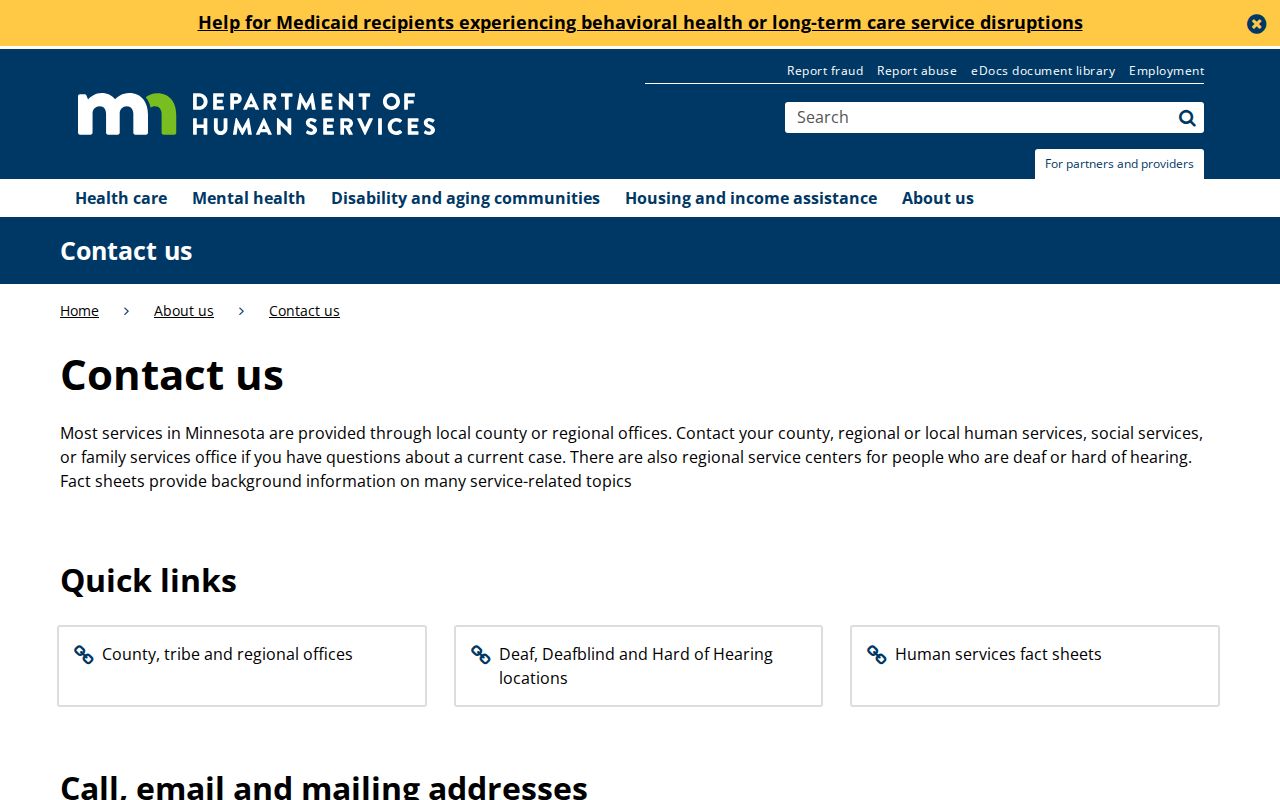
Eligibility for food support, child care help, and cash assistance is usually decided at the county or tribal level, so a state call often ends with a county phone number.
Crisis response is county work too. Hennepin County shows what that looks like in practice, with adult mental health emergencies going to Cope at 612-596-1223, family and youth crisis at 612-979-9511, the adult behavioral health center at 612-879-3115, and the shelter hotline at 612-204-8200. Those are Hennepin numbers, not statewide ones. For substance use referrals anywhere in Minnesota, the national SAMHSA helpline is 1-800-662-4357.
County Phone Numbers Across Minnesota
Counties do far more here than people expect. Sheriffs, jails, public health, social services, property records, the recorder, elections, child support, veterans services, and court administration all sit at that level in Minnesota. Each county maintains a separate website and a separate phone list, which is why pinning down the county name comes before anything else.
Hennepin County publishes a general information line at 612-348-3000, open weekdays from 8 a.m. to 4:30 p.m., and then routes most work through service pages rather than one flat employee list. Ramsey County goes the other way and runs an actual searchable staff directory.
The Ramsey County phone directory takes the first few letters of a first name, a last name, or a department.
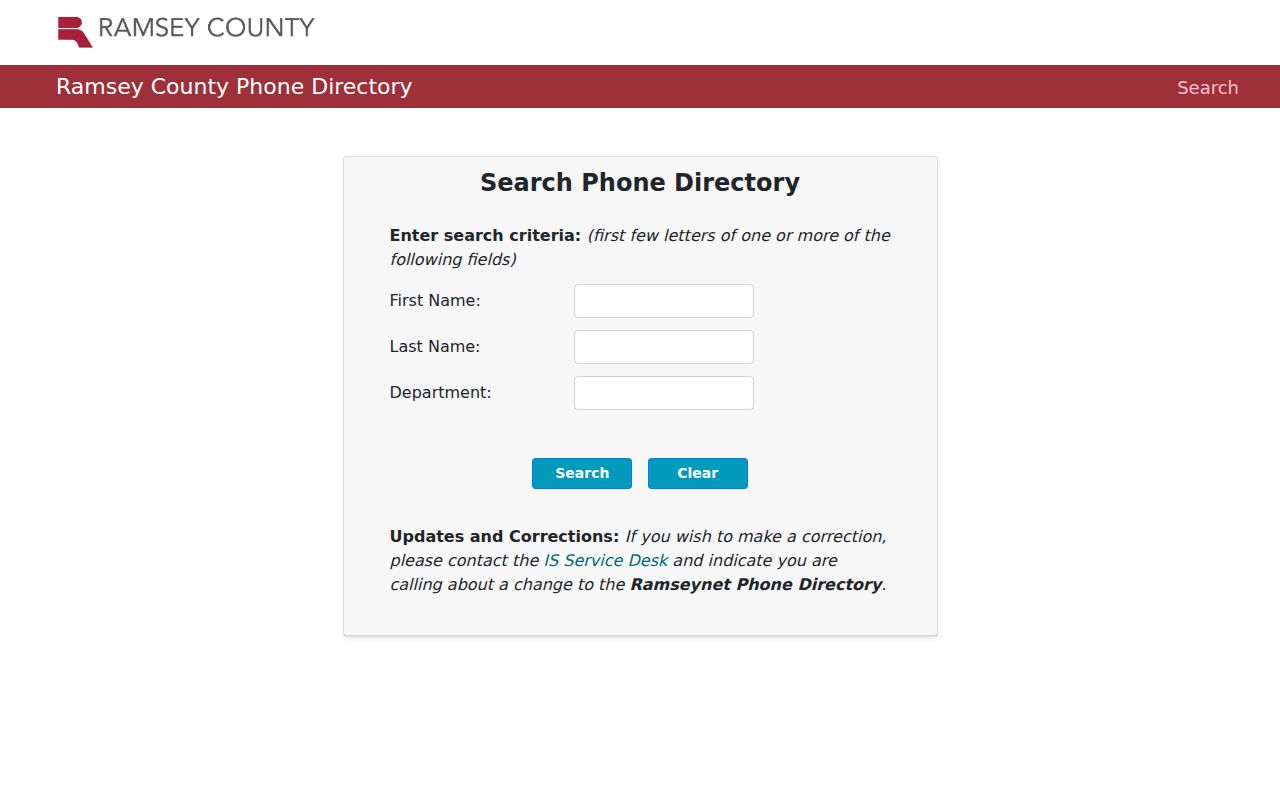
Partial entries work well there, so a department name alone is often enough to get a usable list.
On the state side, the offices people call most are the Attorney General at 651-296-3353 in the Twin Cities or 800-657-3787 elsewhere, MnDOT at 651-296-3000 or 800-657-3774, and the Public Utilities Commission at 651-296-0406. Minnesota Relay serves all of them at 800-627-3529.
Checking an Unknown Minnesota Number
Start with the official side, because it is free and it does not guess. Federal complaint systems will not hand you a name, but they will tell you whether a number has a pattern behind it and give you somewhere to file. Third-party tools may return a name, a carrier, or a spam label, and the quality varies by tool and by number. Nothing on either side is proof of who called.
| Tool | Type | What It Gives You |
|---|---|---|
| FCC Consumer Complaints Center | Official | A place to file a phone complaint, plus support at 888-225-5322 |
| FTC Do Not Call Registry | Official | Registration and unwanted-call reporting |
| Minnesota Attorney General | Official | Consumer complaint intake and scam alerts |
| NANPA code records | Official | Which area code and prefix were assigned where |
| NumLookup, Truecaller, YouMail | Third party | Possible name, phone type, or spam label |
| Carrier apps | Carrier | Spam and scam warnings on your own line |
What each of those tools actually hands back, and the order to try them in, is covered on the Minnesota phone numbers page.
Robocalls and Scam Calls in Minnesota
Minnesota has been active on robocalls. In August 2025 the Attorney General joined 50 attorneys general in Operation Robocall Roundup, sending warning letters to 37 voice providers suspected of ignoring FCC rules meant to keep illegal robocalls off the network. The office also publishes a plain-language guide to unwanted telemarketing that explains why the Do Not Call list alone does not stop the calls. Criminals using spoofed caller ID and cheap internet phone service simply do not follow the law.
Only a handful of scripts do the rounds. Callers claim to be law enforcement and demand gift cards or cryptocurrency to clear a warrant. Others spoof a utility and threaten a shutoff within the hour. In September 2025, Minnesota Management and Budget warned that callers posing as the State of Minnesota were asking vendors to update banking details, and said state agencies do not make unsolicited requests like that. Spoofed numbers usually wear a local code, so a 612, 651, 763, or 952 number in the metro, or 507, 924, 218, or 320 elsewhere, is no reason to trust a caller.
Reports go to more than one place, and they serve different purposes. Unwanted telemarketing goes to the FTC Do Not Call Registry. Spoofing, blocked caller ID, and spam-label problems go to the FCC Consumer Complaints Center. Money lost to a Minnesota business or a caller pretending to be one goes to the Attorney General complaint form. Phone company billing and service disputes go to the Public Utilities Commission.
Minnesota Community and Language Phone Lines
211 is the number for the moment when you know what you need and not who provides it. United Way answers it statewide, day and night, free and confidential. The specialists on the other end search health and human services for a living. The same service picks up at 800-543-7709, and a text with your ZIP code to 898-211 gets a reply as well.
The United Way 211 Minnesota service covers housing, food, utility help, and dozens of other categories.
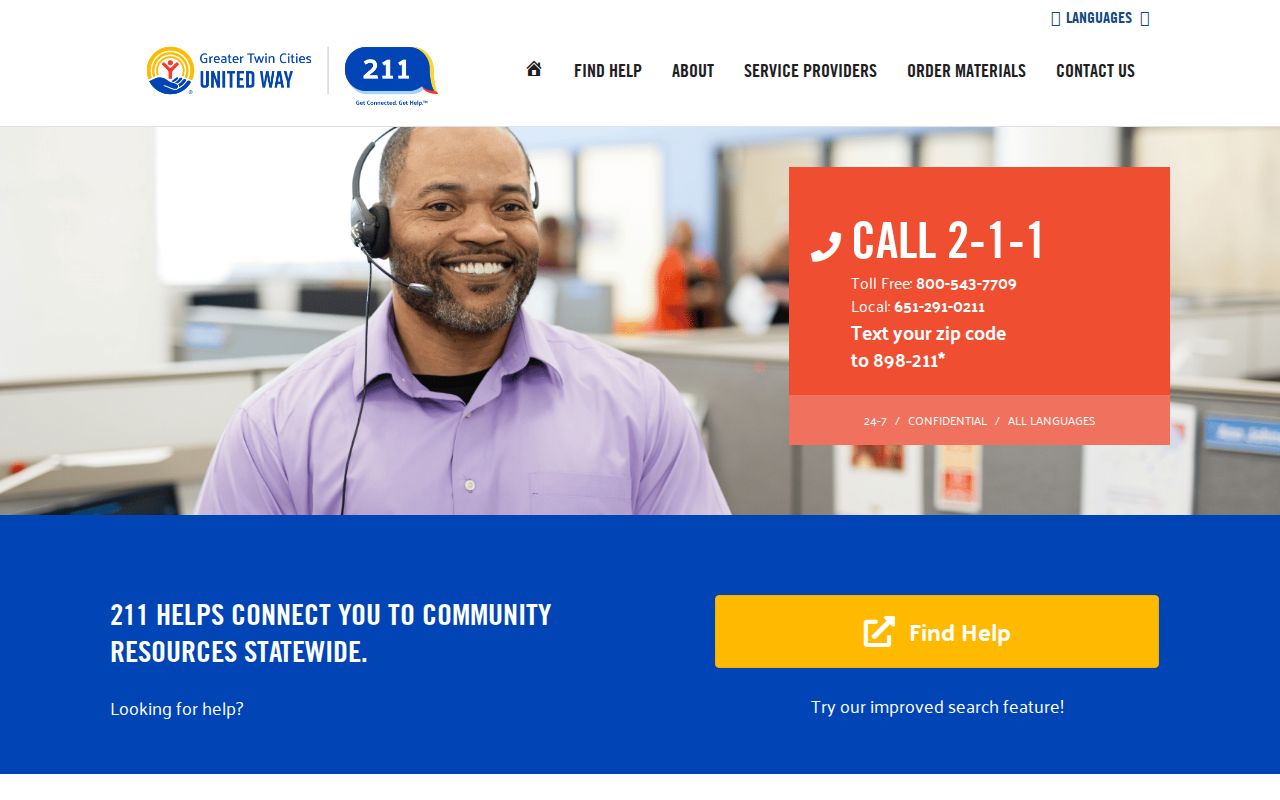
It is also the fastest route to county human services when you do not know which county office handles your case.
Language access is a real strength here, and it is easy to miss. Minnesota.gov carries Spanish, Hmong, and Somali navigation. The education department staffs its own language line. Greater Twin Cities United Way works as a Minnesota partner on the 988 crisis line. Beyond that, county veterans service offices, tribal government offices, chambers of commerce in Minneapolis, Saint Paul, Rochester, and Duluth, and the Minnesota Council of Nonprofits all publish member and office directories that hold numbers no government list carries.
Reading a Minnesota Phone Number
Take 612-673-3000, the Minneapolis city line, and break it into three parts. 612 is the area code. 673 is the prefix, which once pointed at a specific switch building. 3000 is the line. Save the whole thing, or the +1 version of it, and the number keeps working if the owner moves across the metro or switches carriers.
Prefixes leave fingerprints in Minnesota. State health numbers cluster in 651-201. Human services numbers cluster in 651-431. Minneapolis city numbers run through 612-673, Hennepin County through 612-348, and Metro Transit through 612-373. Those patterns help you recognize a real agency number, but they prove nothing on their own, since a caller can fake any of them.
- NPA
- The numbering plan area, which is the three-digit area code at the front.
- NXX
- The central office code, meaning the three digits after the area code.
- Overlay
- A second area code added over the same ground, which is what 924 did to 507.
- Rate center
- The billing area a prefix is assigned to, such as Duluth, Rochester, or Minneapolis.
The dialing side of all this, including the three-digit service codes and the star codes, lives on the Minnesota phone codes page.
The Story Behind Minnesota Phone Numbers
Two codes covered the whole state when the numbering plan began in 1947. 218 held the north and the west. 612 held the Twin Cities and everything south of them. That arrangement lasted seven years. In 1954 the southern band pulled away as 507, taking pieces of both original codes, and Rochester, Mankato, and Winona got a code of their own.
Then nothing changed for more than forty years. Growth in central Minnesota and around the Twin Cities broke that streak in a hurry. 320 came out of 612 in 1996. Saint Paul and the east metro left for 651 in 1998. In 2000 the suburbs split again into 763 in the north and west and 952 in the south and southwest. Each split shrank 612 until it covered little more than Minneapolis, which is exactly when the code turned into a piece of city identity.
The company side has its own thread. Much of Minnesota sat in Northwestern Bell territory, which became US West, then Qwest, then CenturyLink and Lumen through a run of mergers. That history never covered the whole state. Telephone cooperatives and independent local carriers have served parts of greater Minnesota for generations, and many still do.
Recent Changes to Minnesota Phone Service
The biggest recent change was the 924 overlay in southern Minnesota. The Public Utilities Commission approved it in April 2023 under docket P-999/M-22-461, after NANPA forecast that 507 would run short of numbers. Permissive ten-digit dialing started on January 30, 2024. Ten-digit dialing became mandatory for local calls in the region on July 30, 2024. Carriers could hand out the first 924 numbers on August 30, 2024.
Two other items are worth knowing. The Attorney General's Operation Robocall Roundup landed in August 2025, and Minnesota Management and Budget put out a vendor banking scam alert the following month. On the crisis side, the health department continues to publish Minnesota data and system pages for 988, which has been running nationally since July 2022.
Note: Dialing rules and code assignments change, so check current NANPA and Minnesota PUC notices before relying on older dialing advice.
Frequently Asked Questions
Is ten-digit dialing required in Minnesota?
Southern Minnesota, yes. Since July 30, 2024, a local call inside the 507 and 924 region needs the area code in front of it, and a seven-digit attempt simply fails. The rest of the state is looser. Seven-digit local dialing still connects in various places, depending on the carrier and where the local calling boundary falls. Since ten digits connect from every Minnesota phone regardless, saving contacts with the area code attached spares you from ever checking which rule is in force.
What is the 924 area code, and is it a real Minnesota number?
It is real and it is local. 924 is an overlay on 507, which means it covers the same southern Minnesota ground rather than a new region. Rochester, Mankato, Winona, Worthington, Fairmont, and the smaller towns across the south can all get 924 numbers. Nobody with a 507 number had to change it. New lines and additional lines are where 924 shows up, so it tends to appear first on new businesses, new phones, and second lines rather than long-held household numbers.
Where are Minnesota state employee numbers listed?
They sit in the Minnesota State White Pages, searchable by name and narrowed by an agency dropdown when you know the department. Payroll records drive the matching, so a legal first name beats a nickname. The brief view hands back name, agency, email, and phone. The full view adds a title, a mailing address, and a fax line. Over 100 results means the search needs a first name or an agency added to it. Nothing at all usually means the person is not on state payroll, and the agency contact page is the next place to look.
Who do I call for non-emergency police in Minnesota?
That depends entirely on where you are, because no statewide non-emergency line exists. Saint Paul takes reports about past incidents at 651-291-1111. Minneapolis pushes many of those reports through 311 or an online form, with precinct desks answering at 612-673-5701, 612-673-5702, and 612-673-5703. Outside the metro the answer is the city police department or the county sheriff, whichever covers your address. Anything happening right now, or anyone in danger, is a 911 call instead.
Can I dial 311 anywhere in the state?
No, and that trips up a lot of people. 311 belongs to individual cities in Minnesota, so it works in Minneapolis and does nothing in most other places. The Minneapolis version is the fullest one, with 612-673-3000 behind it, plus an app, a web form, email, and relay service from 7 a.m. to 7 p.m. on weekdays. Everywhere else the substitute is a city hall switchboard, a city clerk, or a single department line. County matters such as public health or property records never go through 311 at all.
Where do robocall complaints go in Minnesota?
Before anything else, write down the calling number, the number it reached, any callback number, and the date and time. Telemarketing complaints belong at donotcall.gov, and the FTC consumer response line is 1-877-382-4357. Spoofing and caller ID trouble belongs with the FCC, reachable at 888-225-5322. Lost money, or a caller pretending to be a real business, belongs with the Minnesota Attorney General at 651-296-3353 or 800-657-3787. Detail is what makes a complaint useful, so a saved voicemail helps more than a general description.